
In the fast-paced world of trading — whether crypto, forex, futures, or options — automation has become a game-changer. Trading bots execute strategies 24/7 without emotion, but many traders still lose money. One major reason is poor risk management when scaling up. Running multiple bots simultaneously can boost diversification and profits, yet it also multiplies risks if not handled correctly. Overlapping positions, excessive leverage, or poor capital allocation can quickly lead to a blown account.cb12e5ae9e6d
This comprehensive guide covers proven strategies to run multiple bots safely. You’ll learn capital allocation, diversification, monitoring, and practical setups for sustainable growth in 2025–2026.
Why Run Multiple Trading Bots?
Running several bots offers clear advantages:
Diversification: Spread risk across strategies, assets, and timeframes. One bot might scalp forex during London session volatility, while another grids crypto in a ranging market.
Increased Opportunity Capture: Bots cover more pairs or markets than a single human or bot could manage.
Strategy Optimization: Assign specific roles — one for trend-following, another for mean-reversion, and a third for arbitrage.
Reduced Emotional Bias: Each bot operates independently with predefined rules.
According to various platforms and trader reports, experienced users often converge on 3–5 bots for a good balance between diversification and oversight.78c281
However, the downsides are real: strategy conflicts, hidden leverage stacking on correlated assets, and monitoring overload. Proper systems prevent these issues.964f3d
Understanding the Core Risks
Before scaling, recognize the main pitfalls:
Overexposure: Multiple bots trading the same or correlated assets (e.g., BTC and ETH) can unintentionally create oversized positions.
Leverage Stacking: In futures or forex, one bot’s 10x position combined with another can equal dangerous effective leverage.
Drawdown Correlation: In a market crash, all bots may lose simultaneously.
Technical Failures: API issues, VPS downtime, or conflicting orders.
Overtrading: Too many bots leading to excessive fees or slippage.
The goal is controlled, diversified automation — not chaos.3350c0
Step 1: Capital Allocation — The Foundation of Safety
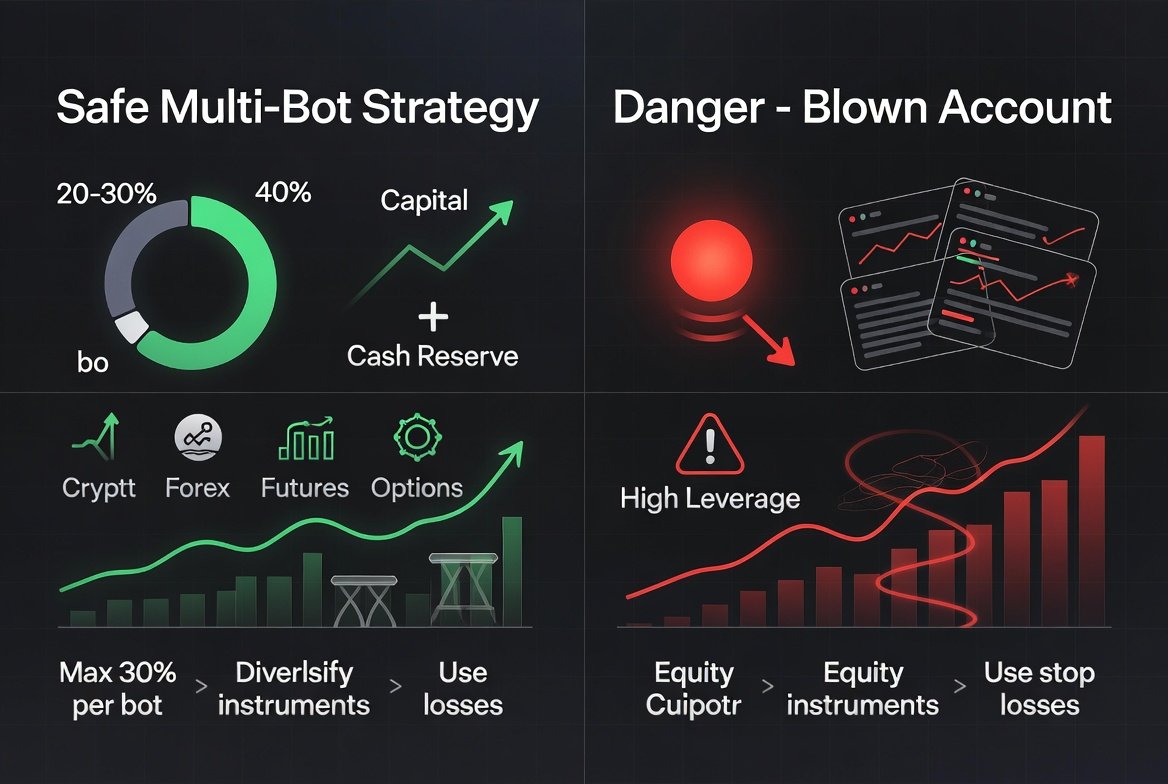
Never run multiple bots on your full account balance. Allocate specific portions to each bot or strategy.
Recommended Rule: Risk no more than 1% of total capital per individual trade across all bots, and limit total portfolio risk.
Here’s a sample capital allocation table for a $10,000 account:
Bot #
Strategy Type
Allocation %
Capital ($)
Max Risk per Trade
Max Drawdown Limit
1
Crypto Grid (BTC/ETH)
20%
2,000
0.5–1%
10%
2
Forex Scalper (EUR/USD)
15%
1,500
0.5%
8%
3
Futures Trend (BTC)
15%
1,500
0.75%
12%
4
Options Covered Call
10%
1,000
0.5%
7%
5
Arbitrage/Stable
10%
1,000
0.3%
5%
Cash/Reserve
30%
3,000
–
Key Takeaway: Keep 20–40% in cash or low-risk reserves for opportunities or buffers. Adjust allocations based on backtested performance.b126a5
For position sizing, use formulas like:
Fixed Fractional: Risk a fixed % of current equity per trade.
Kelly Criterion (conservative version): For advanced users, but halve the suggested size for safety.
Volatility-Based: Size positions inversely to ATR (Average True Range).
Example: With $10,000 total and 1% risk ($100), if stop-loss is 2% away from entry, position size = $100 / 0.02 = $5,000 notional exposure.
Step 2: Diversify Strategies and Assets
Avoid overlap. Assign clear roles to each bot:
Different Market Conditions: Trend, range, breakout, volatility.
Different Assets: Crypto spot/futures, major forex pairs, stock indices, commodities.
Different Timeframes: Scalping (minutes), swing (hours/days), position (weeks).
Different Logic: Rule-based, AI/ML, arbitrage, DCA, grid, signal-following.
Strategy Diversification Table:
Strategy
Best Market Condition
Risk Level
Correlation Risk
Recommended Pairs/Assets
Grid Trading
Ranging
Medium
Low
BTC/USDT, ETH/USDT, EUR/USD
DCA (Dollar Cost Avg)
Trending up
Low
Medium
Blue-chip cryptos, major forex
Scalping
High Volatility
High
Low
Liquid forex pairs, BTC futures
Trend Following
Strong Trends
Medium
High
BTC, Gold, Nasdaq futures
Arbitrage
Inefficiencies
Low
Very Low
Cross-exchange or spot-futures
Options (Iron Condor)
Neutral
Medium
Medium
Indices, high-IV stocks
Run bots on separate or sub-accounts where possible to isolate risks. Many exchanges (Binance, Bybit) support sub-accounts.1b4bd6
Step 3: Technical Setup for Multiple Bots
VPS/Cloud Hosting: Use reliable VPS (e.g., for 24/7 uptime). Run bots in isolated environments or containers (Docker) to prevent conflicts.2b6d8c
API Management: Use unique API keys per bot with restricted permissions (trade only, no withdrawals).
Exchange Accounts: Prefer multiple accounts or sub-accounts. This prevents one bot’s actions from interfering with others.
Software Choices: Platforms like 3Commas, Pionex, custom Python bots, or MT4/MT5 EAs support multi-bot setups. Ensure they have portfolio-level risk controls.fbd15c
Start small: Test 2 bots in demo mode for 1–2 months, then go live with tiny allocations and scale gradually.
Step 4: Implement Robust Risk Management Rules
Every bot and the overall portfolio needs these safeguards:
Stop-Loss & Take-Profit: Mandatory on every position. Use trailing stops.
Maximum Drawdown Limits: Bot-level (e.g., 10%) and portfolio-level (e.g., 15–20%). Auto-pause when hit.91494b
Daily/Weekly Loss Limits: Stop trading after a set loss threshold.
Position & Exposure Limits: Cap open positions or total notional exposure.
Correlation Checks: Manually or via tools, avoid heavy exposure to highly correlated assets (e.g., limit total BTC-related risk to 15–20% of portfolio).
Leverage Caps: Lower leverage when running multiple futures/options bots.
Global Risk Table (Portfolio Level):
Metric
Conservative
Moderate
Aggressive
Max Risk per Trade
0.5%
1%
1.5%
Total Open Exposure
30–40%
50–60%
70–80%
Portfolio Drawdown Limit
10%
15%
20%
Max Correlated Exposure
15%
25%
35%
Bots Recommended
2–3
3–5
5–8
Rebalance monthly: Review performance, withdraw profits, and adjust allocations.8c167e
Step 5: Monitoring, Maintenance & Optimization
Automation doesn’t mean “set and forget.” Dedicate time weekly:
Track individual bot PnL, win rate, drawdown, and Sharpe ratio.
Use dashboards (TradingView, exchange APIs, or third-party tools) for aggregate view.
Log everything: Trades, performance metrics, and incidents.
Regular backtesting and forward-testing of parameters.
Emergency protocols: Have manual override plans and alerts via Telegram/Discord.
Tools like Altrady, 3Commas, or custom scripts help aggregate multi-bot performance.44caca
Common mistakes to avoid:
Chasing performance by adding more bots after wins.
Ignoring fees and slippage in multi-bot setups.
Running all bots during major news without filters.
Neglecting security (API key leaks, weak VPS).
Real-World Example / Case Study
Imagine a $20,000 portfolio:
Bot 1 (Crypto Grid): $4k allocation → Steady small gains in sideways market.
Bot 2 (Forex Trend): $3k → Captures GBP/USD moves.
Bot 3 (Futures Mean-Reversion): $3k with tight stops.
Reserve: $10k.
During a 2025 crypto dip, correlated bots trigger drawdowns, but portfolio-level limits pause them at 12% total loss. Cash reserve allows buying dips manually or restarting conservatively. Result: Account survives and recovers faster than a single aggressive bot would.
Traders report that proper multi-bot setups often achieve smoother equity curves with lower maximum drawdowns compared to single-bot aggression.03a044
Advanced Tips for 2025–2026
AI-Enhanced Bots: Use adaptive risk features that auto-adjust based on volatility or regime detection.
Auto-Compounding with Caution: Reinvest profits gradually, but pair with risk reduction on losses.f21503
Multi-Exchange: Spread across Binance, Bybit, forex brokers for better liquidity and risk hedging.
Tax & Compliance: Track trades properly, especially across crypto and traditional markets.
Machine Learning Correlation: Advanced setups analyze real-time asset correlations to dynamically adjust sizes.
Conclusion: Discipline Beats Complexity
Running multiple trading bots simultaneously is powerful for scaling profits in crypto, forex, futures, and options. But success hinges on iron-clad risk management, clear allocation, diversification, and consistent monitoring — not the number of bots.
Start conservative, document everything, and scale only after proven live performance. Treat your trading capital like a business: protect i6t first, then grow it.
Remember, no bot is foolproof. Markets evolve, black swans happen, and past performance isn’t indicative of future results. Combine automation with ongoing education and human oversight.
If you’re ready to implement these strategies safely, explore reliable trading bots or platforms with strong risk controls and portfolio features. Test thoroughly in demo environments first. Sign up for a free trial and join the future of responsible trading!