
In an era where headlines scream about robots stealing livelihoods, it’s easy to picture a dystopian workplace stripped bare by artificial intelligence (AI). Picture this: assembly lines humming without human hands, chatbots handling customer queries 24/7, and algorithms crunching data faster than any analyst ever could. The fear is palpable—30% of U.S. workers worry their jobs will be replaced by AI or similar tech by the end of 2025. Yet, beneath this anxiety lies a counter-narrative backed by hard data: AI isn’t a job destroyer; it’s a job multiplier. Far from ushering in mass unemployment, AI automation is poised to generate more opportunities than it displaces, reshaping the workforce into something more dynamic, inclusive, and human-centered.
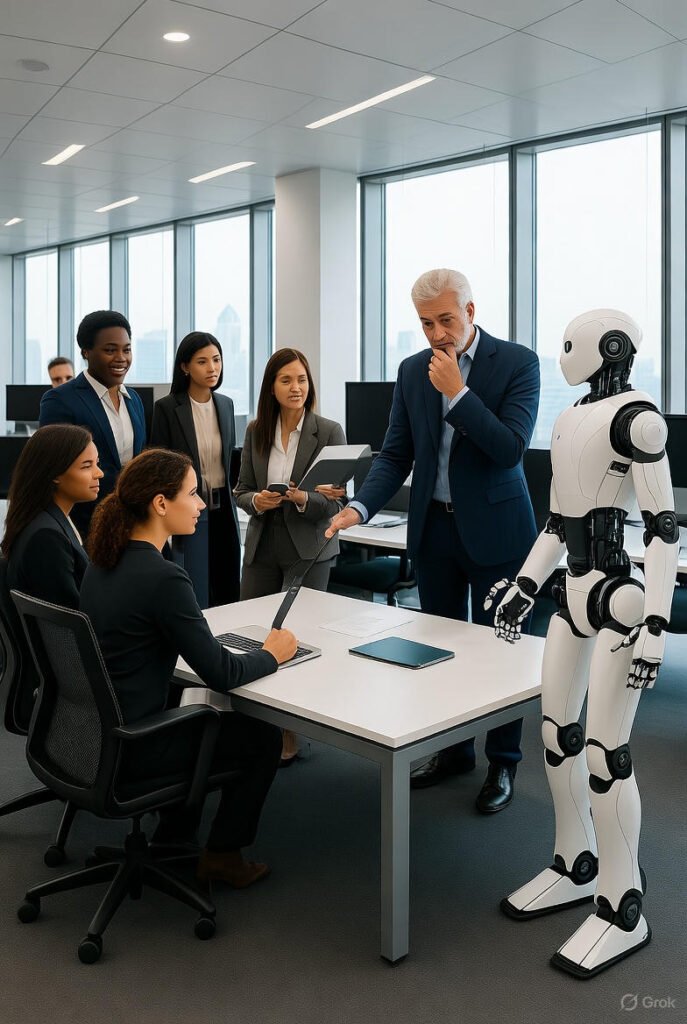
This isn’t wishful thinking. Reports from leading think tanks paint a picture of net job growth. The World Economic Forum’s (WEF) Future of Jobs Report 2025 forecasts that by 2030, technological advancements like AI will create over 170 million new jobs worldwide, while displacing just 92 million—resulting in a net gain of 78 million roles. Similarly, McKinsey’s analysis suggests that while up to 30% of current U.S. jobs could be automated by 2030, the ripple effects of increased productivity will spawn entirely new industries and positions. The key? AI doesn’t eliminate work; it evolves it, freeing humans from drudgery to tackle complex, creative challenges. In this article, we’ll explore how history echoes this truth, dive into the latest statistics, spotlight emerging roles, and chart the path to thriving in this AI-augmented future. Buckle up— the job market of tomorrow is brighter than you think.
Lessons from History: Automation’s Track Record of Job Creation
To understand AI’s role in the future of work, we must first rewind the clock. Automation isn’t new; it’s been revolutionizing labor for centuries, often sparking the same doomsday predictions we hear today. Take the Industrial Revolution: steam engines and mechanized looms displaced artisans and farmhands en masse in the 19th century. Riots erupted—remember the Luddites smashing weaving machines in protest? Yet, what followed wasn’t widespread idleness but an explosion of employment. Factories birthed roles in engineering, management, and logistics, swelling the workforce from agrarian toil to urban industry. By 1900, global labor participation had surged, with new sectors like railroads and electricity creating millions of jobs that didn’t exist a generation prior.
Fast-forward to the 20th century: computers arrived, and with them, fears of a “useless class.” In the 1980s, as personal computers infiltrated offices, typists and file clerks saw their numbers plummet. But the digital age didn’t crater employment; it catapulted it. Software development, IT support, and data analysis roles proliferated, turning what was once a niche into a multi-trillion-dollar economy. A Goldman Sachs report from August 2025 echoes this pattern, estimating that while AI could initially displace 6-7% of the U.S. workforce if widely adopted, the productivity boost—potentially adding 7% to global GDP—will more than offset losses through new demand.
These historical parallels aren’t coincidences. Automation excels at rote, repetitive tasks, but it amplifies human ingenuity where it matters most: innovation, empathy, and strategy. AI follows suit. Unlike past mechanization, which was rigid and sector-specific, AI is adaptive, integrating into every industry from healthcare to hospitality. A PwC 2025 Global AI Jobs Barometer reveals that sectors heavily exposed to AI—think finance and IT—have seen job postings grow 3.5 times faster than in less-automated fields since 2020. The result? Not fewer workers, but more valuable ones. As AI handles the mundane, humans pivot to oversight, customization, and ethical decision-making, creating a virtuous cycle of growth.
Consider the automotive industry. Robotic arms on assembly lines slashed manual welding jobs by 40% in the 1990s, but they also birthed demand for robot programmers, safety inspectors, and supply chain optimizers. Today, AI-driven predictive maintenance in factories prevents breakdowns before they happen, saving billions and spawning roles in data orchestration. The pattern holds: each wave of automation prunes the low-value branches of work while cultivating a lush canopy of high-skill opportunities. By 2025, we’re not at the tipping point of job apocalypse—we’re in the midst of a renaissance.
The Data Tells the Story: Net Gains in a Transforming Landscape
Skeptics might dismiss history as prologue, but 2025’s data is unequivocal: AI is fueling job creation at a pace that outstrips displacement. The WEF’s comprehensive survey of over 1,000 global employers—representing 14 million workers—projects that AI and related tech will drive the fastest job growth through 2030. Top risers include AI and machine learning specialists (up 40%), big data analysts (up 35%), and fintech engineers (up 30%). Meanwhile, declining roles like data entry clerks and administrative secretaries will shrink by 20-25%, but these losses are dwarfed by gains elsewhere.
McKinsey’s 2025 State of AI report reinforces this, noting that two-thirds of jobs in the U.S. and Europe are exposed to some degree of AI automation, with a quarter facing high risk. Crucially, though, exposure doesn’t equate to extinction. The firm estimates that AI could automate activities equivalent to 45% of work hours by 2030, but this will liberate workers for higher-value tasks, potentially boosting labor productivity by 40%. In a survey of 1,500 organizations, 90% reported AI saving time on routine work, with 85% saying it helps focus on strategic priorities. The bottom line? AI isn’t a zero-sum game; it’s an expander.
Zooming in on sectors, healthcare exemplifies the upside. AI diagnostics tools like those from Google DeepMind now flag anomalies in scans with 95% accuracy, reducing radiologist burnout. But rather than culling jobs, they’ve increased demand for clinical AI integrators and patient-AI liaisons—roles blending tech with bedside manner. PwC’s barometer shows that in AI-exposed healthcare jobs, wage premiums have risen 25% since 2023, as workers leverage AI for personalized care plans. In finance, algorithmic trading displaced some traders, yet it created quants and compliance officers to navigate AI’s black-box decisions, with global fintech employment up 15% year-over-year.
Even in creative fields, once thought immune, AI sparks proliferation. Tools like DALL-E for image generation haven’t killed artists; they’ve democratized design, birthing prompt engineers who craft inputs for bespoke outputs. A 2025 Autodesk report on AI in design notes a 143% surge in AI engineer postings, alongside non-technical roles like AI content strategists. Globally, the International Labour Organization predicts AI will add 12 million jobs in developing economies by 2027 through e-commerce automation and remote work enablers.
Of course, challenges persist. Youth unemployment hovers at 13% in AI-vulnerable sectors, per the WEF, and entry-level gigs in admin and retail face the steepest cuts—up to 40% of employers plan workforce reductions there. A Stanford study from August 2025 found a 6% employment dip for 22-25-year-olds in high-AI-exposure occupations since 2022. Yet, these are transition pains, not terminal ones. With proactive reskilling, the net trajectory bends upward. As J.P. Morgan’s 2025 research highlights, only 10% of firms use AI regularly mid-year, meaning adoption—and thus job creation—is accelerating.
Emerging Roles: The New Frontier of AI-Augmented Careers
What does this job boom look like on the ground? Forget the sci-fi trope of obsolete humans; the reality is a constellation of hybrid roles where AI and people co-create value. Leading the charge: AI ethics specialists, who ensure algorithms don’t perpetuate biases—demand for these has spiked 200% since 2023, per Harvard’s 2025 career outlook. Machine learning engineers, tasked with training models on vast datasets, command salaries averaging $150,000, with openings up 50% globally.
Then there’s the prompt engineer, a title that didn’t exist five years ago but now boasts 135% growth in postings. These wizards optimize AI interactions for tools like ChatGPT, turning vague queries into precise outputs for marketing or coding. In robotics, AI oversight specialists monitor autonomous systems in warehouses, a role projected to grow 60% by 2030 as firms like Amazon scale drone deliveries. Data scientists evolve into AI product managers, bridging tech teams and business needs to launch tools that automate yet enhance human workflows.
Non-technical paths abound too. Human-AI collaboration trainers teach workers to partner with bots, a field exploding with 350,000 new U.S. roles in 2025 alone. Sustainability analysts use AI for climate modeling, aligning with the WEF’s prediction of 10 million green jobs by decade’s end. Even in education, AI curriculum designers craft personalized learning paths, countering fears of teacher obsolescence.
These aren’t isolated; they’re interconnected. A New York Times analysis from June 2025 lists 22 AI-spawned jobs, from virtual reality therapists to blockchain-AI auditors, emphasizing that nine million displacements will pale against emergent demand. The common thread? These roles demand uniquely human traits—curiosity, ethics, adaptability—amplified by AI’s efficiency.
Upskilling for the AI Era: Your Roadmap to Relevance
Thriving amid this shift hinges on skills evolution. The WEF warns that 39% of core job skills will transform by 2030, with technological proficiencies like AI literacy surging in priority. PwC notes skills in AI-exposed jobs evolve 66% faster—over 2.5 times quicker than last year—demanding lifelong learning. McKinsey’s report urges organizations to lower skill barriers via AI tutors, enabling proficiency in any field, anytime.
For individuals, start with platforms like Coursera for machine learning basics or LinkedIn Learning for prompt engineering. Employers should invest in hybrid training, blending AI tools with soft skills like critical thinking. Governments play a part too: subsidies for reskilling could unlock $6.5 trillion in economic value by 2030, per McKinsey.

Embracing the Abundance: A Call to Action
The future of work isn’t a battle against AI—it’s a collaboration with it. By creating more jobs than it takes, automation heralds an era of abundance, where drudgery yields to discovery. As the WEF aptly states, new categories of work will emerge, displacing some but elevating all. For businesses, this means partnering with AI experts to automate wisely and upskill boldly. At [Your Company], our AI and automation services help you navigate this landscape— from custom integrations to workforce training programs tailored for 2025 and beyond.
Don’t fear the machine; master it. The jobs of tomorrow await those ready to seize them. What’s your first step?
