
What Is Backtesting in Trading?
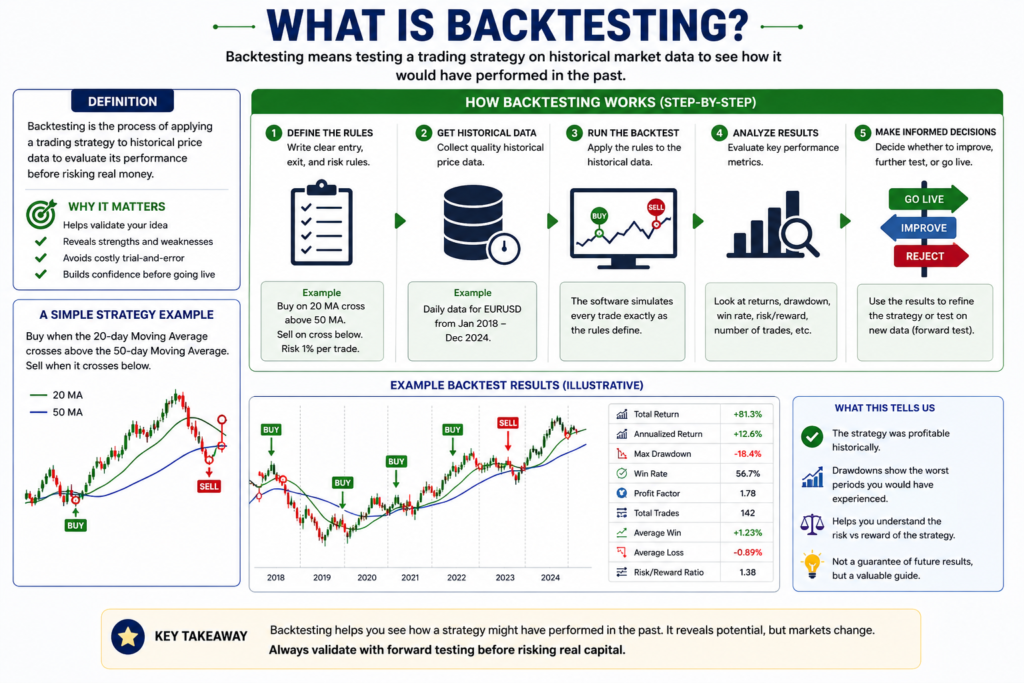
Backtesting is the process of testing a trading strategy against historical market data to see how it would have performed in the past.
Instead of risking real money immediately, a trader applies specific rules to historical price data and measures the potential results.
For example, a strategy might say:
- Buy when the 20-day moving average crosses above the 50-day moving average.
- Sell when the opposite crossover occurs.
- Risk only 1% of the trading account per position.
Backtesting allows the trader to ask an important question:
“If I had followed these rules in the past, what would have happened?”
However, a profitable backtest does not automatically mean the strategy will make money in the future.
Why Backtesting a Trading Strategy Matters
Backtesting can help traders identify whether a strategy has a reasonable historical foundation before putting real capital at risk.
It can help you:
- Measure historical profitability.
- Identify periods of large losses.
- Understand maximum drawdown.
- Test different market conditions.
- Compare different strategy variations.
- Remove some emotional decision-making from strategy evaluation.
- Determine whether a strategy is worth further testing.
The goal is not to prove that a strategy will work. The goal is to determine whether the strategy has shown enough evidence to justify further testing.
How Does Trading Strategy Backtesting Work?
A basic backtest usually follows these steps:
1. Define the Trading Rules
The strategy must have clear entry, exit, position-sizing and risk-management rules.
A vague rule such as “buy when the market looks strong” cannot be properly backtested.
2. Choose Historical Market Data
The trader selects historical data for a specific asset, timeframe and period.
The quality of this data matters. Poor or incomplete data can produce unreliable results.
3. Apply the Strategy
The strategy’s rules are applied consistently to the historical data.
The system records trades, entry prices, exits, profits, losses and other relevant statistics.
4. Analyse the Results
Important metrics include:
- Net profit: Total gains minus total losses.
- Win rate: Percentage of profitable trades.
- Risk-to-reward ratio: Average potential reward compared with average risk.
- Maximum drawdown: Largest decline from a peak in account value.
- Profit factor: Gross profit divided by gross loss.
- Number of trades: Helps determine whether the results are based on enough observations.
Looking only at total profit can be misleading. A strategy making 40% with a 35% drawdown may be very different from one making 25% with a 10% drawdown.
Can You Really Trust Backtesting Results?
Not completely.
Backtesting is useful evidence, but it is not a crystal ball.
The biggest problem is that historical markets are already known. When a strategy is repeatedly adjusted to produce better historical results, the trader can accidentally create a strategy that is excellent at explaining the past but poor at handling the future.
This is known as overfitting.
For example, imagine testing dozens of combinations of moving averages until one produces an exceptional historical return.
The result may look impressive, but the chosen settings could simply be optimised for that particular historical period.
When market conditions change, the strategy may fail.
Common Backtesting Mistakes
Overfitting
A strategy becomes too closely adapted to historical data and loses its ability to generalise to new market conditions.
Look-Ahead Bias
The backtest accidentally uses information that would not have been available at the time a historical trade was supposedly made.
This can make results appear much better than they realistically would have been.
Ignoring Trading Costs
Commissions, spreads, slippage and other transaction costs can significantly reduce actual returns, particularly for high-frequency or short-term strategies.
Using Poor Data
Incorrect prices, missing data or survivorship bias can distort results.
Testing Too Few Trades
A strategy that looks profitable after 10 trades does not provide the same level of evidence as one tested across hundreds or thousands of trades.
Ignoring Market Conditions
A strategy might work well during a strong bull market but struggle during sideways or highly volatile conditions.
Backtesting vs Forward Testing
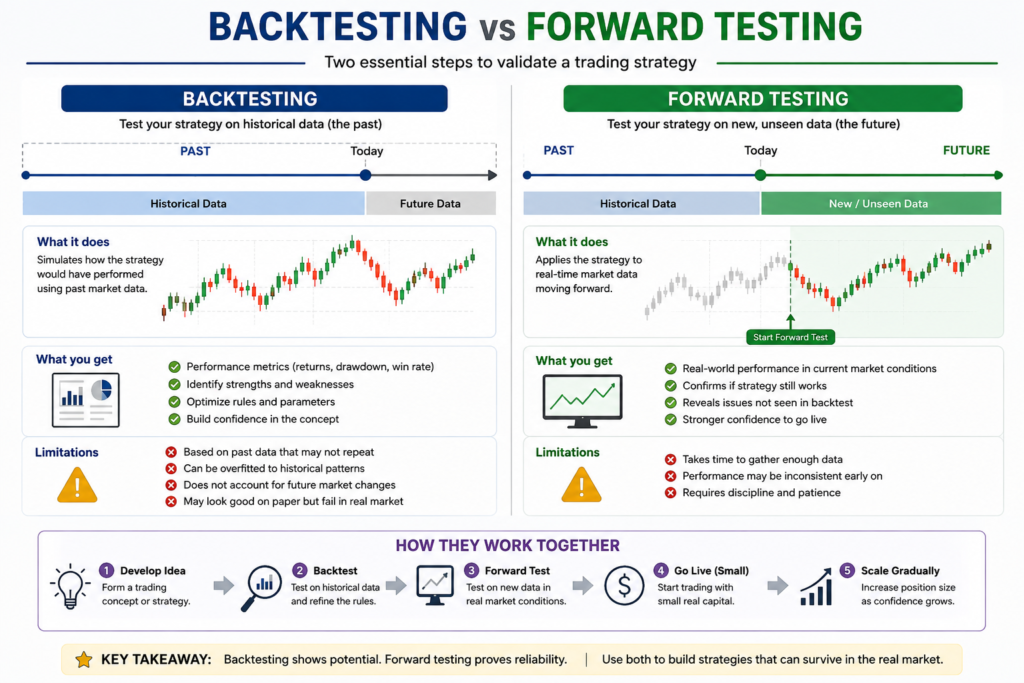
Backtesting uses historical data.
Forward testing evaluates the strategy using new, unseen market data.
This distinction is important.
A strategy can perform exceptionally well during backtesting but produce disappointing results when exposed to new market conditions.
A stronger testing process therefore looks something like this:
Historical Data → Backtest → Optimisation → Out-of-Sample Test → Forward Test → Live Trading
The further a strategy progresses through independent testing, the more confidence you can have in its robustness.
How to Make Backtesting More Reliable
To improve the quality of a trading strategy backtest:
Use realistic assumptions.
Include spreads, commissions, slippage and realistic execution conditions.
Separate your data.
Use one period for developing the strategy and another unseen period for testing it.
Test different market conditions.
Include bullish, bearish, sideways and highly volatile periods where possible.
Avoid excessive optimisation.
More parameters do not necessarily create a better strategy.
Use enough trades.
A larger sample can provide stronger evidence than a handful of successful trades.
Focus on risk-adjusted performance.
Don’t judge a strategy purely by its return. Consider drawdown, volatility, consistency and risk.
The Biggest Lesson: A Backtest Is Evidence, Not a Guarantee
The most important thing to understand about backtesting trading strategies is that past performance does not guarantee future results.
A good backtest should answer:
“Does this strategy have evidence of a repeatable edge?”
It should not be used to claim:
“This strategy will definitely make money.”
Markets change. Liquidity changes. Volatility changes. Trading costs change. And strategies that worked under one market environment can stop working under another.
Backtesting is therefore best viewed as one stage of strategy validation, not the final proof that a trading system is profitable.
Final Takeaway
Backtesting is one of the most valuable tools available to systematic traders—but only when used correctly.
A profitable backtest is a starting point, not a guarantee.
The strongest approach combines backtesting, out-of-sample testing, forward testing, realistic trading costs and disciplined risk management.
The real objective isn’t to create the most impressive historical equity curve.
It is to build a strategy that has a reasonable chance of surviving when the future doesn’t look like the past.
Visit our store to explore our trading solutions