
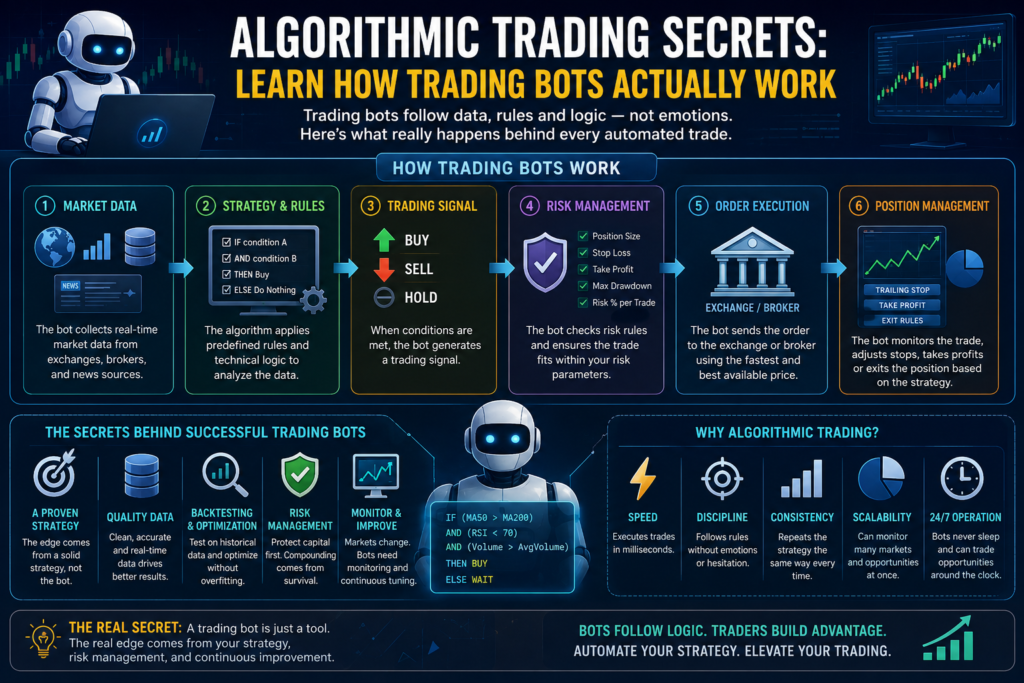
Trading bots can appear mysterious from the outside. However, most successful trading bots are built around a simple idea: turn a defined trading strategy into rules that software can execute automatically.
Instead of watching charts manually, an algorithm can analyze market data, identify specific conditions, and place or manage trades according to predefined instructions. Because computers can process information quickly and consistently, algorithmic trading is widely used by individual traders, funds, banks, and professional trading firms.
But a trading bot is not a magic money-making machine. Its performance depends on the quality of its strategy, data, execution, and risk controls.
How Do Trading Bots Actually Work?
A typical trading bot follows a logical process:
Market Data → Strategy Rules → Trading Signal → Risk Check → Order Execution → Position Management
1. Market Data
First, the bot receives information such as price, volume, spreads, order-book data, or other market indicators.
For example, a strategy might monitor whether the price of an asset moves above its 50-period moving average.
2. Strategy Rules
Next, the algorithm applies predefined rules to the data.
For example:
If the price crosses above the moving average and the trend condition is confirmed, generate a buy signal.
Therefore, the bot does not “guess” what the market will do. Instead, it follows the conditions programmed into the strategy.
3. Trading Signals
When the required conditions are met, the system generates a signal such as buy, sell, hold, or exit.
However, generating a signal does not necessarily mean the bot immediately enters a trade. Good systems usually perform additional checks first.
4. Risk Management
Before placing an order, the algorithm can check position size, stop-loss levels, maximum daily loss, exposure, and available capital.
For example, a risk rule might limit every trade to 1% of the trading account.
This is important because a profitable strategy without proper risk management can still produce damaging losses.
5. Order Execution
After the risk checks are satisfied, the bot sends an order through a broker or exchange.
Depending on the system, it may use market orders, limit orders, stop orders, or more advanced execution methods.
Moreover, professional systems may consider factors such as spread, liquidity, slippage, and execution speed before completing the trade.
The Main Secret: Trading Bots Follow Rules, Not Emotions
One of the biggest advantages of algorithmic trading is consistency.
A human trader may hesitate after a loss, enter a trade because of fear of missing out, or close a position too early. A properly designed algorithm, on the other hand, follows its programmed rules regardless of emotions.
For example, if the strategy says to exit when a stop-loss level is reached, the bot can execute that instruction without fear or hesitation.
Nevertheless, removing emotions does not remove risk. A poorly designed algorithm can consistently make the wrong decisions at high speed.
back-testing: How Traders Test a Trading Bot
Before deploying an algorithm with real money, traders often use back-testing.
back-testing involves running a strategy against historical market data to see how it would have performed under past conditions.
A back-test can reveal:
- Historical returns
- Maximum draw-down
- Win rate
- Average profit and loss
- Number of trades
- Risk-adjusted performance
- Periods of poor performance
However, a strong back-test does not guarantee future profits.
Why? Because historical markets may behave differently from future markets. In addition, excessive strategy optimization can create over-fitting, where a strategy performs extremely well on historical data but poorly in real trading.
Therefore, traders should combine back-testing with out-of-sample testing, forward testing, and realistic trading costs.
How Trading Bots Make Decisions
Trading algorithms can use many different approaches.
Technical Indicators
Bots can use indicators such as moving averages, RSI, MACD, Bollinger Bands, and ATR to identify potential market conditions.
Price Action
Some algorithms focus directly on price behavior, including breakouts, trends, support and resistance, and volatility.
Arbitrage
Arbitrage algorithms attempt to identify price differences between markets or related instruments and execute trades quickly before the opportunity disappears.
Statistical Strategies
Statistical algorithms analyze historical relationships and probabilities to identify potential trading opportunities.
High-Frequency Trading
High-frequency systems use extremely fast infrastructure and sophisticated algorithms to execute large numbers of trades in very short periods.
Consequently, not every trading bot is built for the same purpose. A simple retail bot and a professional high-frequency system can be dramatically different in complexity.
What Makes a Trading Bot Good?
A reliable algorithmic trading system usually has several important characteristics:
Clear strategy: The rules should be specific enough to test and reproduce.
Quality data: Poor or incomplete data can produce misleading results.
Strong risk management: Position sizing, stop-losses, exposure limits, and draw-down controls are essential.
Realistic testing: back-tests should account for spreads, commissions, slippage, and execution limitations.
Monitoring: Even automated systems need supervision because markets, APIs, brokers, and infrastructure can fail.
Adaptability: Market conditions change. Therefore, traders should regularly evaluate whether a strategy still behaves as expected.
Common Mistakes When Building Trading Bots
Automation can create the illusion that everything is under control. However, several mistakes can undermine an algorithm.
Over-Optimizing the Strategy
Adding too many rules to make historical results look better can lead to over-fitting.
Ignoring Transaction Costs
A strategy may look profitable before commissions and spreads but become unprofitable after realistic costs are included.
Using Poor Risk Controls
Even a strategy with a statistical edge can experience losing streaks. Therefore, risk limits should be designed before live deployment.
Assuming Automation Means Profit
Automation improves execution and consistency; it does not automatically create a profitable strategy.
Failing to Monitor the System
Technical failures, unexpected volatility, API problems, and data errors can affect automated trading.
Algorithmic Trading vs Manual Trading
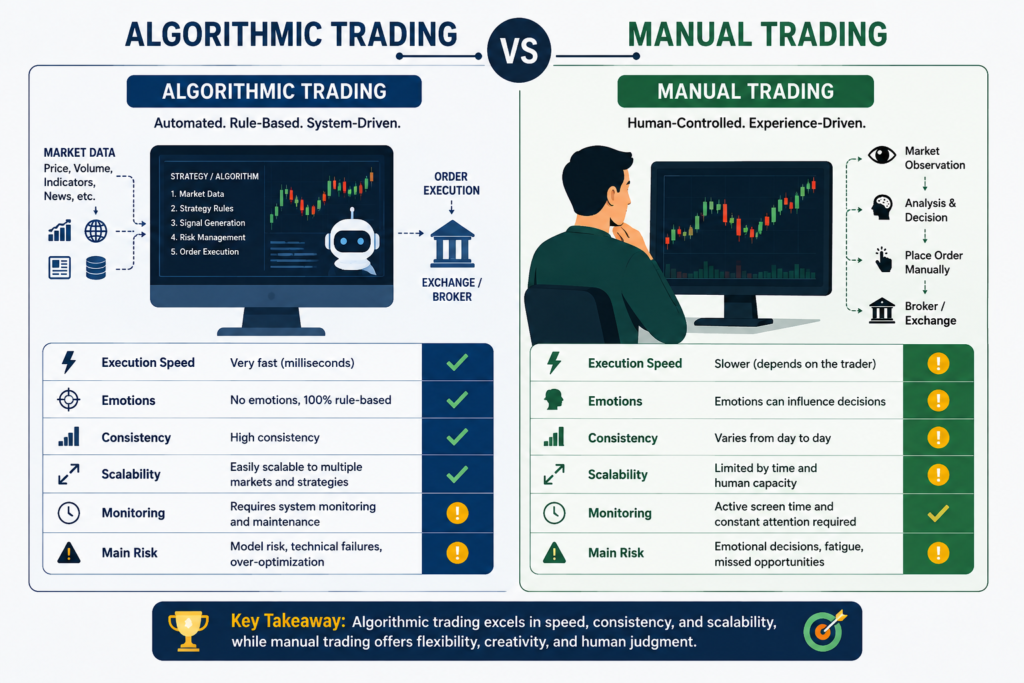
| Feature | Algorithmic Trading | Manual Trading |
|---|---|---|
| Execution | Automated | Human-controlled |
| Emotions | Reduced | Can influence decisions |
| Speed | Very fast | Usually slower |
| Consistency | Rule-based | Depends on trader |
| Monitoring | Software-based | Human observation |
| Scalability | High | More limited |
| Main Risk | Model/system failure | Human error/emotional decisions |
Neither approach is automatically superior. Instead, the best choice depends on the strategy, trader, market, technology, and risk tolerance.
The Real Secret Behind Trading Bots
The biggest secret is that the bot itself is rarely the source of the trading edge.
A bot is primarily a tool for executing a strategy.
If the underlying strategy has no genuine advantage, automating it simply allows the trader to lose money more efficiently. Conversely, a well-tested strategy combined with disciplined risk management and reliable execution can benefit significantly from automation.
Therefore, successful algorithmic trading is less about finding a “perfect bot” and more about developing a testable strategy, controlling risk, validating results, and executing consistently.
Final Takeaway
Algorithmic trading is essentially the process of converting trading decisions into systematic rules that software can execute.
Trading bots collect market data, analyze predefined conditions, generate signals, check risk, execute orders, and manage positions. However, automation alone does not guarantee success.
For that reason, traders should focus on strategy quality, realistic back-testing, risk management, execution, and continuous monitoring rather than simply searching for a bot that promises guaranteed profits.
The smartest approach is not to ask, “Which trading bot will make me money?” Instead, ask:
“What trading advantage can I prove, automate, test, and manage responsibly?”
visit our store to explore our trading solutions