
Trading is not simply about finding profitable opportunities. It is also about controlling what happens when a trade goes wrong. This is where a Risk Manager becomes one of the most important components of an automated trading system.
A trading strategy may identify when to enter or exit a market, but the Risk Manager determines how much capital should be exposed, how large a position should be, and when trading should be restricted or stopped.
In simple terms, the strategy looks for opportunities; the Risk Manager protects the account.
What Is a Risk Manager?
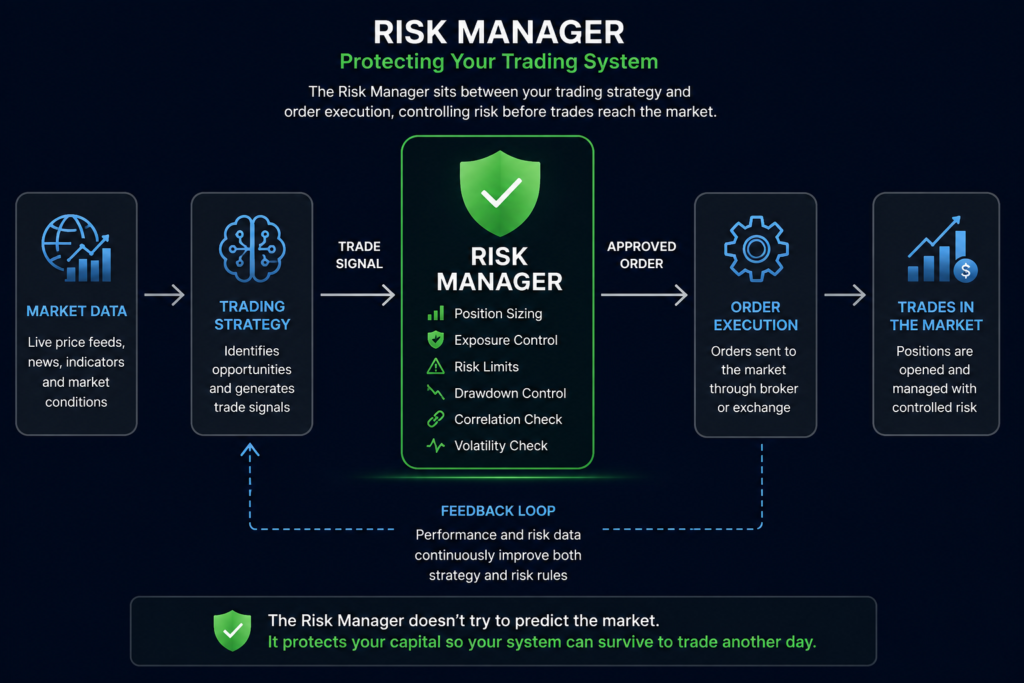
A Risk Manager is a set of rules, calculations, and algorithms designed to control the amount of risk a trading system takes.
Instead of allowing a trading algorithm to execute every signal at the same position size, the Risk Manager evaluates factors such as:
- Available account capital
- Position size
- Stop-loss distance
- Market volatility
- Maximum allowable loss
- Current exposure
- Number of open positions
- Daily loss limits
- Correlation between assets
It then determines whether a trade should be executed, reduced, modified, or rejected altogether.
How Does a Risk Manager Work?
Think of an automated trading system as having several layers.
Market Data → Trading Strategy → Risk Manager → Order Execution
The strategy may say:
“This looks like a good opportunity to buy.”
The Risk Manager then asks:
“How much can we safely risk on this trade?”
If the calculated risk is acceptable, the order can proceed. If the risk is too high, the system can reduce the position or reject the trade.
This separation is important because a profitable strategy can still destroy an account if its risk is poorly controlled.
Key Functions of a Trading Risk Manager
1. Position Sizing
One of the Risk Manager’s most important responsibilities is determining how much to trade.
For example, suppose a trader has a $10,000 account and wants to risk 1% on a trade.
Maximum planned loss:
$10,000 × 1% = $100
The Risk Manager can use the stop-loss distance and other parameters to calculate an appropriate position size.
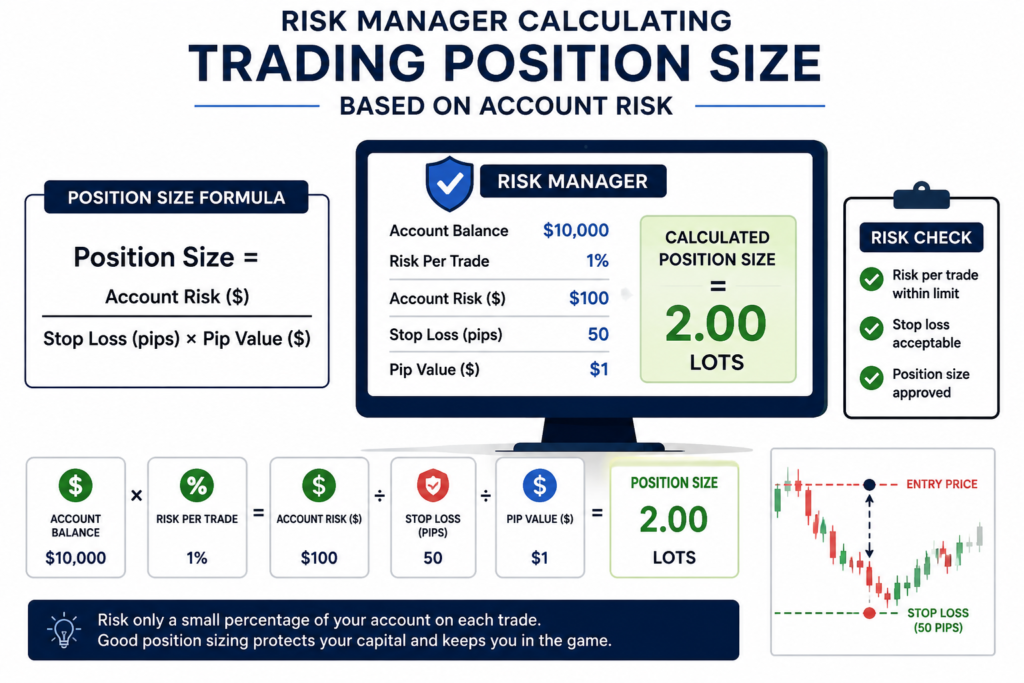
This prevents the system from taking unnecessarily large positions.
2. Stop-Loss Management
A Risk Manager can enforce predefined loss limits.
If a position reaches its maximum acceptable loss, the system can automatically close it rather than allowing the loss to continue growing.
However, stop-losses are not guaranteed protection against every market condition. Gaps, slippage, and extreme volatility can cause actual execution prices to differ from the intended stop price.
3. Exposure Control
A trader may unknowingly take several positions that are heavily exposed to the same market factor.
For example, holding several highly correlated assets can create much more risk than the individual position sizes suggest.
A Risk Manager can therefore monitor total exposure rather than looking at each trade independently.
4. Daily Loss Limits
A trading system can be programmed to stop opening new positions after reaching a predefined daily loss threshold.
For example:
Daily loss limit = 3%
Once that threshold is reached, the Risk Manager can prevent additional trades until the next trading session.
This helps stop a temporary period of poor performance from becoming a much larger drawdown.
5. Volatility Adjustment
Markets do not always behave the same way.
During periods of high volatility, price movements can become larger and faster. A Risk Manager can respond by reducing position sizes or applying stricter trading conditions.
This allows the system to become more defensive when market conditions become unstable.
Risk Manager vs Trading Strategy
These two components perform different jobs.
| Trading Strategy | Risk Manager |
|---|---|
| Finds trading opportunities | Controls trading risk |
| Generates buy/sell signals | Determines acceptable exposure |
| Focuses on market conditions | Focuses on capital protection |
| Attempts to generate returns | Attempts to limit losses |
| Answers “Should we trade?” | Answers “How much risk should we take?” |
The distinction is critical.
A strategy can be profitable but poorly managed. A Risk Manager helps ensure that individual trades and overall exposure remain within predefined limits.
Why the Risk Manager Matters in Algorithmic Trading
Automation makes trading faster, but speed can also amplify mistakes.
A poorly designed algorithm can execute hundreds of trades before a human realizes something has gone wrong.
A properly designed Risk Manager provides a protective layer between the trading logic and the market.
It can respond automatically to situations such as:
- Excessive losses
- Abnormal volatility
- Oversized positions
- Too many simultaneous trades
- Excessive account exposure
- Unexpected market conditions
- Technical or execution problems
This is particularly valuable because risk controls operate according to predefined rules rather than emotions.
What Happens Without a Risk Manager?
Imagine an algorithm generates a valid trading signal.
It enters a position.
The market suddenly moves against it.
Instead of limiting the loss, the system continues trading and potentially increases its exposure.
A small losing trade can then become a significant drawdown.
This is why having a good trading strategy is not enough.
The strategy determines how opportunities are identified. The Risk Manager determines how much damage a losing opportunity is allowed to cause.
Building an Effective Risk Manager
A robust Risk Manager should have clearly defined rules before the system goes live.
Important controls can include:
Maximum risk per trade
Defines how much capital can be lost on an individual position.
Maximum portfolio exposure
Limits the total amount of capital exposed across positions.
Maximum daily drawdown
Determines when trading should be temporarily suspended.
Position limits
Prevents the system from opening excessively large positions.
Volatility controls
Adjusts risk when market conditions become unusually unstable.
Emergency shutdown
Provides a mechanism for stopping the system when predefined critical conditions occur.
The controls should also be backtested and stress-tested rather than simply added to a live system.
Risk Management Is Not a Guarantee Against Losses
An important point is often overlooked: a Risk Manager cannot eliminate trading losses.
Its purpose is to control and contain risk, not guarantee profits.
Even sophisticated systems can experience:
- Slippage
- Market gaps
- Liquidity problems
- Technical failures
- Unexpected news events
- Execution delays
- Model errors
Therefore, risk controls should be designed with realistic assumptions and tested under unfavorable conditions.
The Bigger Picture
A sophisticated automated trading system is not just a strategy that buys and sells.
It is a combination of several components:
Data → Signal Generation → Risk Manager → Execution → Monitoring
Each component has a specific role.
The trading strategy searches for opportunities. The Risk Manager controls exposure. The execution system handles orders. Monitoring ensures the entire system continues to operate as expected.
This layered approach can make an automated trading system more disciplined and resilient.
Visit our store to explore our trading platform