
High-Frequency Trading (HFT) is one of the fastest and most technologically advanced forms of trading in financial markets. Unlike traditional traders who may hold positions for minutes, hours, or days, high-frequency traders use powerful computers and algorithms to analyze markets and execute thousands of trades within milliseconds.
But how does HFT work, and what makes it so fast?
What Is High-Frequency Trading?
High-Frequency Trading is a form of algorithmic trading that uses sophisticated computer systems to execute large numbers of orders at extremely high speeds.
HFT systems continuously monitor financial markets for small price differences, changes in supply and demand, and short-term trading opportunities. When specific conditions are detected, the algorithm can automatically place and cancel orders without requiring a human trader to click a button.
The objective is often not to make a huge profit from one trade. Instead, HFT strategies may seek to capture very small profits repeatedly and at extremely high speed.
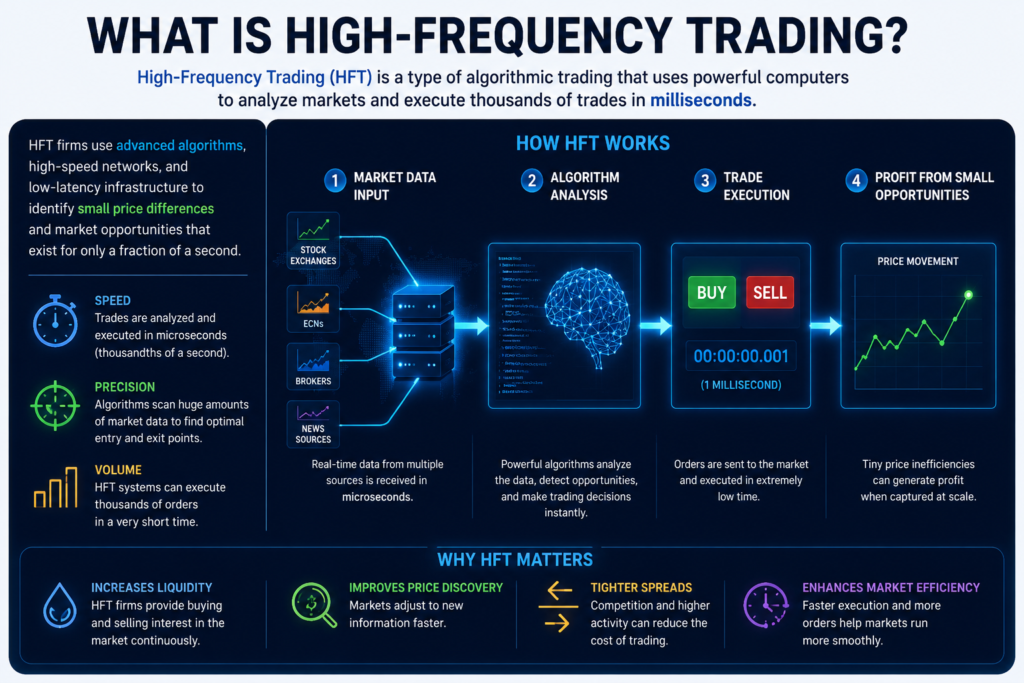
How Does HFT Work?
High-frequency trading depends on several key technologies and processes:
1. Powerful Trading Algorithms
HFT algorithms analyze market data and make trading decisions based on predefined rules. They can process enormous amounts of information much faster than humans.
For example, an algorithm might detect that an asset is temporarily priced differently across two trading venues and attempt to exploit the difference.
2. Ultra-Fast Market Data
Speed is critical. HFT firms receive real-time information about prices, orders, and market activity and process that data almost instantly.
A difference of a few milliseconds can sometimes determine whether a trading opportunity is profitable or disappears.
3. Low-Latency Infrastructure
Latency refers to the delay between receiving information and executing an action.
HFT firms invest heavily in fast networks, optimized software, specialized hardware, and strategically located servers to reduce latency.
This is why milliseconds—and sometimes microseconds—matter.
4. Automated Execution
Once an opportunity meets the algorithm’s conditions, the system can automatically send an order to the market.
There is no need to manually analyze a chart, decide whether to enter, and click “buy” or “sell.”
What Are HFT Strategies?
High-frequency traders can use several strategies depending on market conditions and objectives.
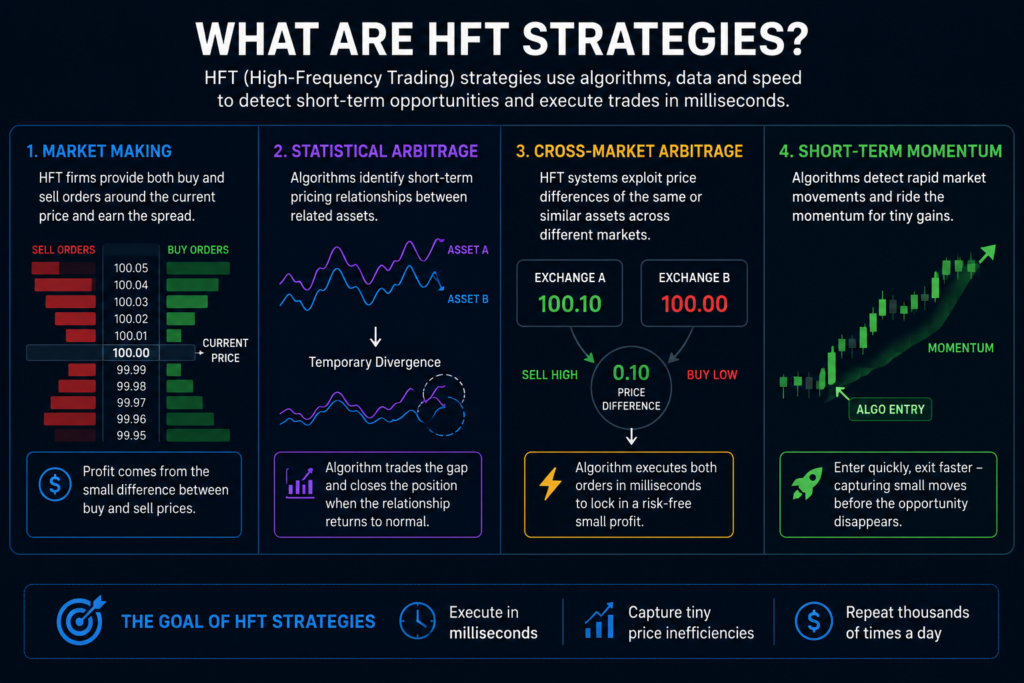
Market making: Algorithms continuously provide buy and sell orders, attempting to earn the spread while managing inventory risk.
Statistical arbitrage: Systems identify short-term pricing relationships between related assets and attempt to profit when those relationships temporarily diverge.
Cross-market arbitrage: Algorithms look for temporary price differences for similar assets across different trading venues.
Short-term momentum strategies: Some systems attempt to identify rapid changes in market activity and respond before the opportunity disappears.
The exact strategies used by professional HFT firms are often highly sophisticated and closely guarded.
Why Is Speed So Important in HFT?
Imagine two traders identify the same $100 asset trading temporarily at $99.98 on one market and $100.00 on another.
A traditional trader may notice the opportunity seconds later. An HFT system, however, may identify and act on it within milliseconds.
By the time a slower trader reacts, the price difference may already be gone.
In HFT, speed is not simply an advantage—it can be part of the strategy itself.
HFT vs Traditional Trading
| High-Frequency Trading | Traditional Trading |
|---|---|
| Executes trades in milliseconds | May take seconds, minutes, or longer |
| Relies heavily on algorithms | Often involves human decision-making |
| Handles very large numbers of trades | Usually fewer transactions |
| Requires advanced infrastructure | Can operate with simpler technology |
| Focuses heavily on short-term opportunities | Can target short- or long-term movements |
What Are the Benefits of HFT?
High-frequency trading can contribute to financial markets in several ways.
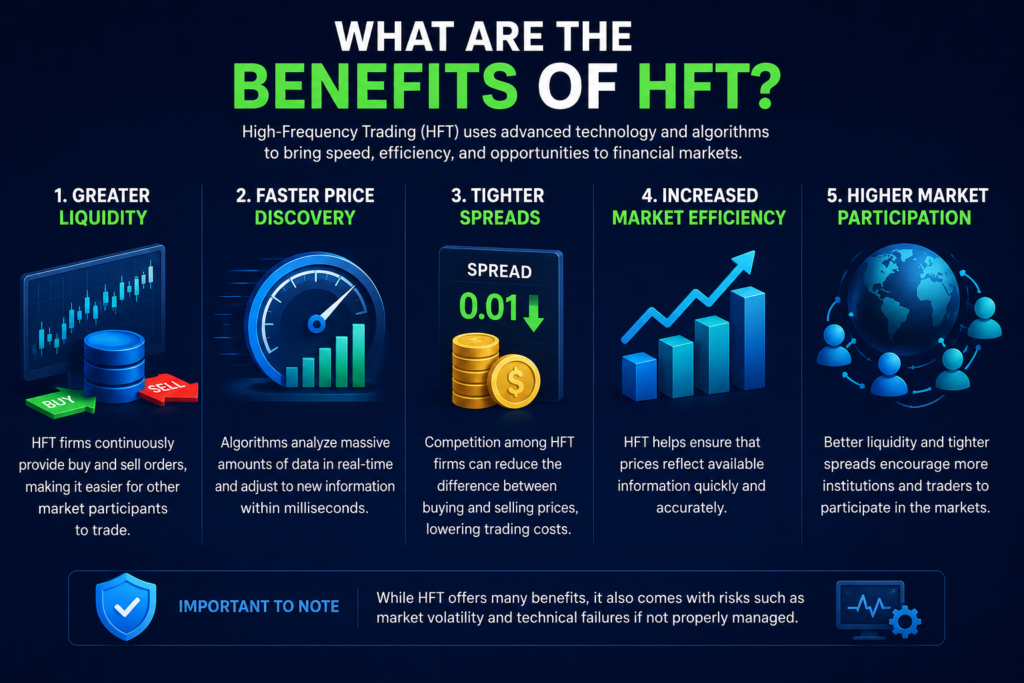
Greater liquidity: HFT firms can continuously provide buy and sell orders, making it easier for other participants to trade.
Faster price discovery: Automated systems can react quickly to new information and changes in market conditions.
Tighter spreads: Competition among market participants can sometimes reduce the difference between buying and selling prices.
However, HFT also introduces risks. Extremely fast automated systems can amplify market movements, and technical failures or poorly designed algorithms can result in significant losses.
The Real Secret Behind HFT
The biggest secret behind high-frequency trading is not simply having a fast computer.
It is the combination of speed, data, algorithms, infrastructure, risk management, and execution.
A faster system with a poor strategy can still lose money. Likewise, a sophisticated algorithm is useless if it cannot execute efficiently or manage risk.
Therefore, successful HFT is better understood as an entire technological ecosystem rather than simply “trading faster.”
Final Takeaway
High-Frequency Trading has transformed the way modern financial markets operate. By combining advanced algorithms, real-time data, automated execution, and ultra-low-latency technology, HFT systems can identify and act on opportunities within milliseconds.
For traders and businesses exploring algorithmic trading, HFT demonstrates an important lesson: technology can dramatically improve the speed and efficiency of decision-making, but speed without a sound strategy and risk management is not enough.
The future of trading will likely continue moving toward greater automation, faster execution, and increasingly sophisticated algorithms
visit our store to explore our trading solutions