
Focus Keyword: Hedging
Keyword Length: 1 word
Power Word: Powerful
Suggested Keyword Density: Approximately 1–1.5%
Article Type: Educational Investment Guide
What Is Hedging?
Hedging is a risk-management technique investors use to reduce the potential impact of an unfavorable price movement on an investment or portfolio.
Think of it as financial protection. Instead of trying to predict exactly what the market will do, an investor takes another position that may offset some or all of the potential loss from the original investment.
For example, an investor holding shares may use an options strategy to protect against a significant decline in the share price.
The goal of hedging is therefore not necessarily to increase profits. It is to control risk and protect capital.
How Does Hedging Work?
Hedging works by creating a second position that has an opposite or partially offsetting exposure to the first.
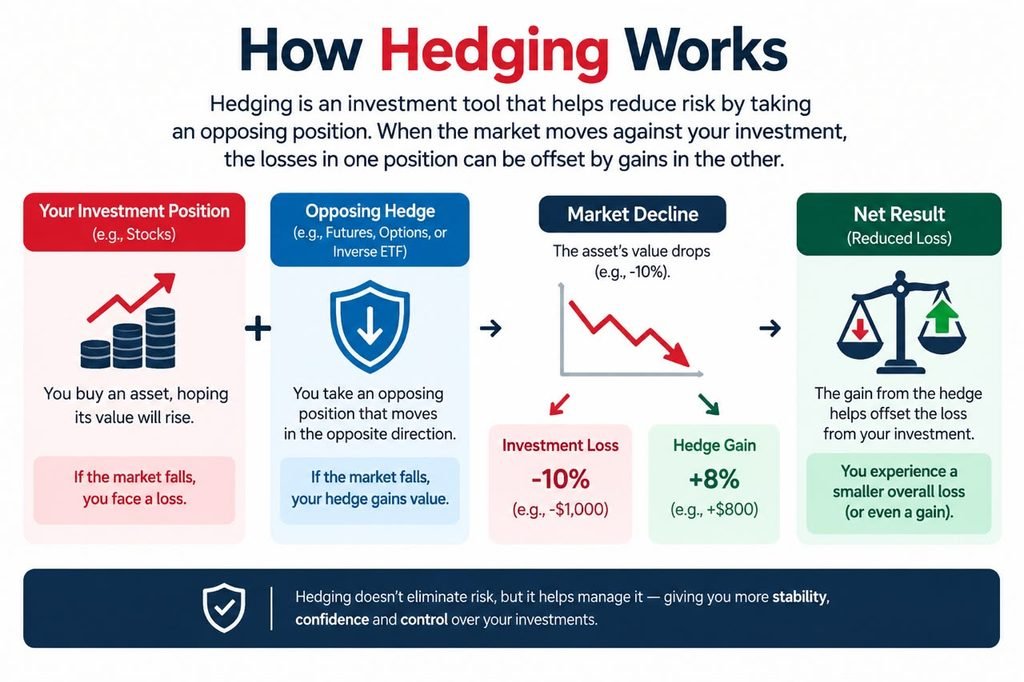
A simple example:
An investor owns shares worth $10,000 and is concerned that the market could fall.
Rather than selling immediately, the investor could use a suitable hedge designed to gain value if the shares decline.
If the shares fall, the original investment loses value, but the hedge may generate a gain that helps reduce the overall impact.
The result is a trade-off: less downside exposure, but potentially less upside or additional costs.
Why Is Hedging Important?
Markets are uncertain. Even a well-researched investment can decline because of economic changes, interest rates, geopolitical events, company-specific news, or unexpected market volatility.
Hedging can help investors manage that uncertainty.
Its main purposes include:
Protecting capital: A hedge can reduce the effect of an adverse price movement.
Managing portfolio risk: Investors can reduce exposure to particular markets, sectors, currencies, or assets.
Reducing volatility: A well-designed hedge may make portfolio performance less sensitive to sudden market movements.
Improving risk control: Investors can focus on their long-term strategy without taking unnecessary short-term exposure.
Common Types of Hedging
Different investors use different hedging techniques depending on their objectives, risk tolerance, and the assets they hold.
1. Options Hedging
Options are commonly used to hedge market exposure.
For example, a protective put gives an investor the right to sell an asset at a specified price, potentially limiting downside if the asset falls significantly.
The advantage is protection. The disadvantage is that the option comes at a cost, usually in the form of a premium.
2. Futures Hedging
Futures contracts allow investors or businesses to lock in prices for an asset at a future date.
This is particularly relevant to commodities, currencies, and interest-rate exposure.
For example, a business that expects to purchase a commodity later may use futures to reduce the risk of an unfavorable price increase.
3. Currency Hedging
Currency movements can significantly affect international investments.
An investor holding foreign assets may use currency hedging to reduce the impact of exchange-rate fluctuations.
This can be particularly useful when the investment itself is performing well but currency movements are reducing the investor’s returns when converted back to the home currency.
4. Diversification as a Form of Risk Control
Diversification is not the same as a direct hedge, but it can reduce concentration risk.
Holding investments across different assets, sectors, or geographic markets can prevent one source of risk from having an overwhelming effect on the entire portfolio.
Hedging vs. Speculation
These concepts are often confused.
Hedging is primarily about reducing existing risk.
Speculation is about taking risk in an attempt to profit from a predicted market movement.
For example, an investor buying an asset because they expect its price to increase is speculating on its future performance.
An investor taking an offsetting position because they already own that asset and want protection against a decline is hedging.
The same financial instrument can therefore be used for completely different purposes depending on the investor’s objective.
The Advantages of Hedging
A well-designed hedge can offer several benefits.
Lower downside risk: Potential losses can be reduced during unfavorable market movements.
Greater portfolio stability: Hedging may reduce dramatic swings in portfolio value.
Better risk management: Investors can define and control specific exposures.
Protection during uncertainty: A hedge can provide a level of protection when market conditions are difficult to predict.
However, hedging is not free and it is not perfect.
The Risks and Limitations of Hedging
Hedging reduces certain risks, but it introduces other considerations.
Hedging Costs
Options premiums, futures costs, spreads, commissions, and other expenses can reduce returns.
Limited Upside
A hedge that protects against losses may also reduce some of the benefit from favorable price movements.
Imperfect Protection
A hedge does not always move perfectly opposite to the original investment. This creates what is known as basis or hedge mismatch risk.
Complexity
Some derivatives and advanced hedging strategies require a strong understanding of pricing, leverage, expiration dates, and market behavior.
Over-Hedging
Too much protection can become expensive and may unnecessarily reduce investment returns.
The objective is therefore not to eliminate every possible risk. It is to manage the risks that matter most.
When Should Investors Consider Hedging?
Hedging may be appropriate when an investor has a meaningful exposure that could create unacceptable losses if the market moves sharply against them.
Common situations include:
- Protecting a large stock position
- Managing foreign-currency exposure
- Reducing commodity price risk
- Protecting profits after a significant market rally
- Managing portfolio exposure during periods of uncertainty
The decision should be based on the cost of protection versus the potential risk being reduced.
A Simple Hedging Example
Imagine an investor owns $20,000 worth of shares.
The investor believes the company has strong long-term potential but is concerned about a possible short-term market decline.
Instead of selling the shares, the investor establishes a hedge designed to gain value if the share price falls.
Three outcomes are possible:
Shares rise: The original investment gains value, but the hedge may lose some of its value or expire unused.
fall moderately: The hedge may offset part of the investment’s decline.
fall sharply: The hedge may provide more significant protection, depending on how it was structured.
This illustrates the central purpose of hedging: accepting a defined cost to reduce potentially larger losses.
How to Use Hedging Effectively
A powerful hedge begins with understanding the risk rather than simply buying a derivative.
Before implementing a hedge, investors should consider:
What am I protecting?
Identify the exact asset or exposure at risk.
How much risk am I willing to accept?
A hedge should match the level of protection actually needed.
What will the hedge cost?
Protection that is too expensive can significantly reduce returns.
What happens if the market rises instead of falls?
Understand both the protection and the opportunity cost.
When should the hedge end?
Define the time period and conditions before entering the position.
The Bottom Line
Hedging is a powerful investment risk-management tool, but it is not a guarantee against losses.
Its purpose is to make risk more manageable—not to remove uncertainty from investing.
The most effective approach is to understand the exposure, identify the risk that matters most, choose an appropriate hedge, and carefully weigh its cost against the protection it provides.
Smart investing is not only about finding opportunities. It is also about protecting your capital when those opportunities do not go as planned.
visit our store to explore our trading solutions