
Focus Keyword: Martingale Trading
Keyword Length: 2 words
Suggested Keyword Density: Approximately 1–1.5%
Article Type: Educational Trading Guide
What Is Martingale Trading?
Martingale Trading is a position-sizing strategy in which a trader increases the size of the next trade after a losing trade, usually with the goal of recovering previous losses when a winning trade occurs.
The traditional approach often involves doubling the position size after each loss. For example, a trader risking $10 could increase the next trade to $20 after a loss, then $40, $80, and so on.
The idea sounds simple: one successful trade could potentially recover the accumulated losses. However, the strategy becomes increasingly risky because the position size grows rapidly during a losing streak.
How Does Martingale Trading Work?
Consider a simple sequence:
| Trade | Position Size | Result |
|---|---|---|
| 1 | $10 | Loss |
| 2 | $20 | Loss |
| 3 | $40 | Loss |
| 4 | $80 | Loss |
| 5 | $160 | Win |
With a simplified 1:1 profit-to-loss structure, the winning trade may recover earlier losses and produce a small net gain.
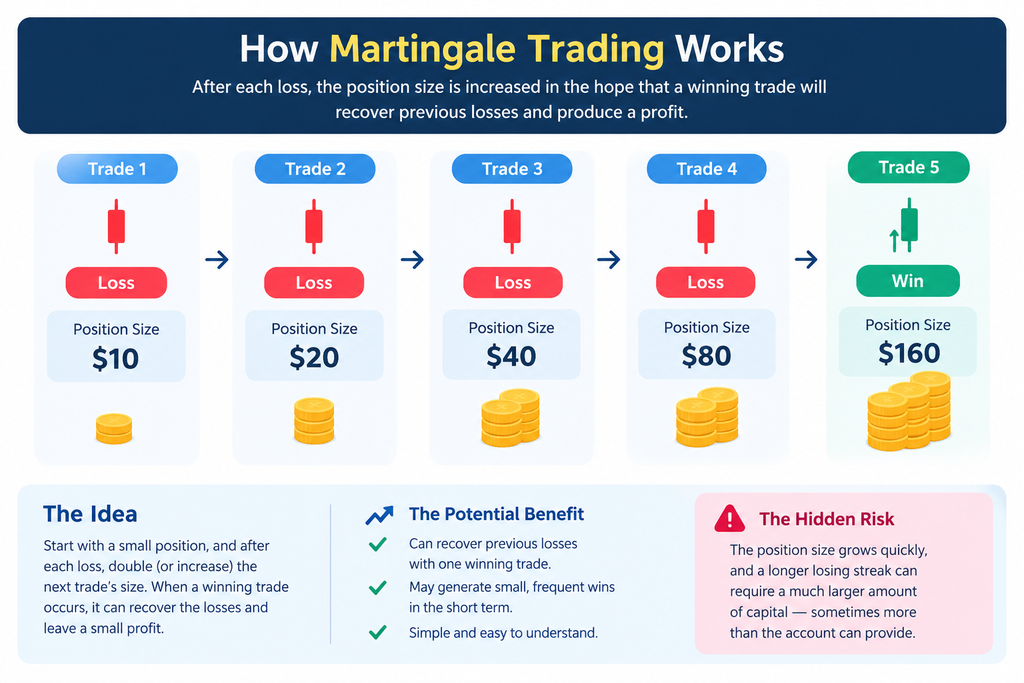
However, notice what happened to the position size. It increased from $10 to $160 in only five trades.
That is the central characteristic of Martingale Trading: small initial risk can become very large exposure when losses continue.
Why Do Traders Use Martingale Trading?
The appeal of Martingale Trading comes from its recovery concept. Traders may believe that losing streaks eventually end and that a sufficiently large winning trade can recover previous losses.
It can also appear attractive because the strategy may generate many periods of small or frequent wins.
However, a high percentage of winning sequences does not automatically mean the strategy has acceptable risk.
The important question is how much capital is required to survive the losing sequences.
The Hidden Risk of Martingale Trading
The biggest weakness of Martingale Trading is the speed at which risk increases.
Starting with $10 and doubling after every loss produces:
$10 → $20 → $40 → $80 → $160 → $320 → $640 → $1,280
After seven consecutive losses, the next position would be 128 times the original $10 trade.
This creates several problems.
1. Capital Requirements Increase Rapidly
A trader needs substantially more capital to continue increasing position sizes. Eventually, the required position may become too large for the account.
2. Leverage Magnifies the Risk
In leveraged markets, increasing position size can make losses grow even faster. A strategy that looks manageable without leverage can become extremely aggressive when leverage is added.
3. Losing Streaks Can Be Longer Than Expected
Markets do not guarantee that a winning trade will appear before capital runs out. A trader may experience a prolonged sequence of losses because of poor market conditions, an ineffective strategy, or a changing market environment.
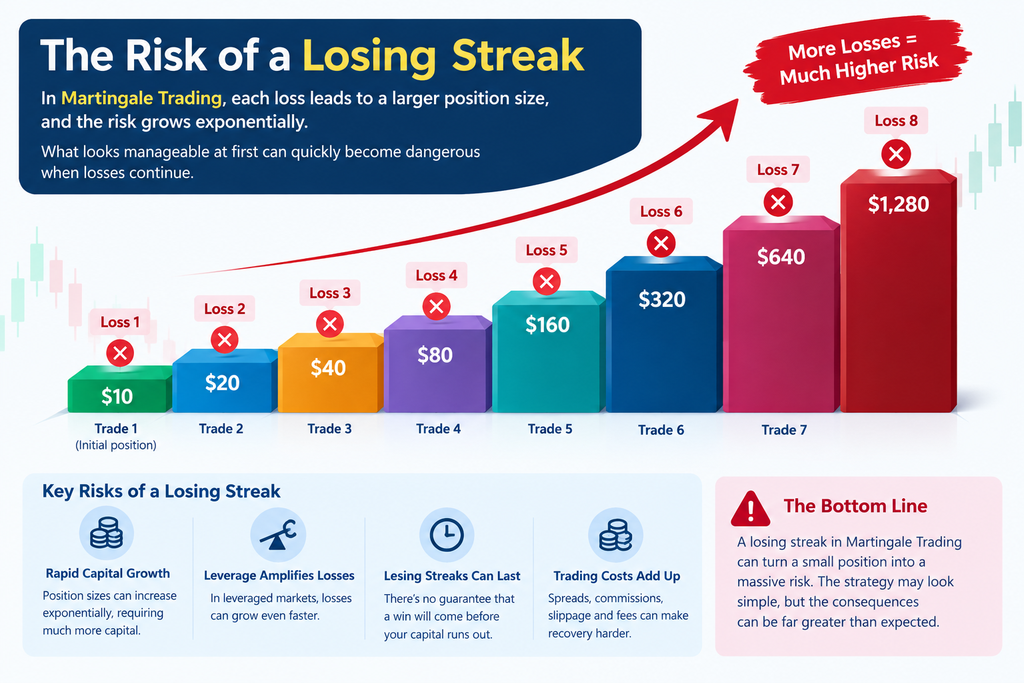
4. Trading Costs Reduce Recovery
Spreads, commissions, slippage, financing charges, and other costs can make the mathematical recovery assumption less favorable than it appears in a simple example.
Martingale Trading vs. Risk Management
Good risk management focuses on survival first and growth second.
Martingale Trading often does the opposite by increasing exposure when the account is already moving in the wrong direction.
For this reason, many traders prefer approaches such as:
Fixed-risk position sizing: Risk a predetermined amount or percentage per trade.
Maximum draw-down limits: Stop trading or reduce exposure after reaching a defined loss threshold.
Stop-loss management: Predetermine the point at which a trade is invalidated.
Risk-reward analysis: Evaluate whether the potential return justifies the amount being risked.
The objective is not to avoid every losing trade. Losing trades are a normal part of trading. The objective is to prevent one losing streak from causing irreversible damage.
Is Martingale Trading Profitable?
Martingale Trading can produce profitable periods, especially when losing streaks remain short and the market behaves favorably.
But profitability alone is not enough to evaluate a strategy.
A proper assessment should examine:
- Maximum draw-down
- Longest losing streak
- Required account capital
- Position-size growth
- Leverage exposure
- Transaction costs
- Probability of ruin
- Performance across different market conditions
A strategy that makes money nine times and suffers a devastating loss on the tenth sequence may not have a favorable long-term risk profile.
Common Mistakes With Martingale Trading
One of the biggest mistakes is assuming that “the next trade has to win.”
It doesn’t.
Another mistake is increasing position size without establishing a maximum level of exposure. A trader may continue doubling until the required position becomes impossible to fund.
Emotional decision-making can make the situation even worse. After several losses, the goal can shift from following a strategy to simply getting the money back. This is known as chasing losses, and it can lead to increasingly aggressive decisions.
Can Martingale Trading Be Modified?
Some traders use modified versions rather than pure doubling.
For example, instead of doubling after every loss, a trader might increase position size by a smaller amount or stop increasing exposure after a predefined number of losses.
These modifications can reduce the speed of risk growth, but they do not remove the underlying problem: loss-based position increases still create additional exposure when the strategy is already experiencing unfavorable results.
Any modified approach should therefore be rigorously tested before real capital is committed.
How to Evaluate a Martingale Strategy
Before considering Martingale Trading, test it under realistic conditions.
Start with historical back-testing, but do not stop there. Examine how the strategy behaves during severe losing streaks, volatile markets, trends, ranging markets, and unexpected price movements.
Then use forward testing or a simulated account to determine whether real-world execution changes the results.
Most importantly, identify the strategy’s worst-case scenario.
Ask:
How many consecutive losses can the account survive?
That question is often more important than asking how frequently the strategy wins.
The Real Lesson Behind Martingale Trading
The main lesson of Martingale Trading is not simply that increasing position size is “bad.” The deeper lesson is that risk can grow much faster than expected when losses are used as a reason to increase exposure.
A trading strategy should be judged not only by its winning trades but also by how it behaves when conditions become unfavorable.
The best trading system is not necessarily the one that avoids losses. It is the one that can survive losses without destroying the account.
Final Takeaway
Martingale Trading is easy to understand but much harder to manage safely. Its promise of recovering losses through larger positions can be appealing, yet the mathematics can quickly create unsustainable exposure during extended losing streaks.
Before using any position-sizing strategy, understand its risk, test it across different market conditions, account for trading costs, and establish clear limits.
In trading, recovery should never come at the expense of survival.
visit our store to explore our trading solutions